
I fell for it again.
Specifically after seeing a “simple” n8n automation video that promised to save me ten hours a week. My brain immediately went into “How” mode: First, how do I connect these APIs? Then, how do I structure this logic? And finally, I obsessed over how to master this tool.
Instead of saving time, I spent the next three days deep in technical forums until 2:00 AM. My nerves are shot and I have a bloated, half-working tool that feels more like a second job than a solution. I didn’t save ten hours; I lost twenty.
As small business owners, we are being told that AI for small business is our greatest ally. But there is a massive, expensive downside no one is talking about: AI is the ultimate “How” trap.
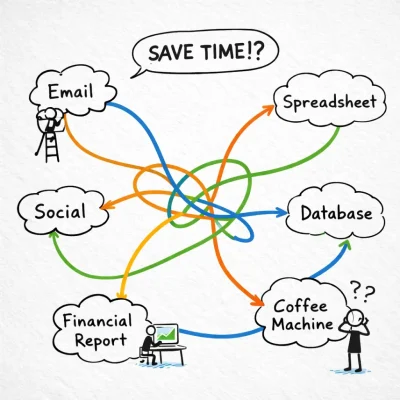
The “Who Not How” Problem
In the book Who Not How by Dan Sullivan and Dr. Benjamin Hardy, the premise is simple: To grow, you must stop asking, “How do I do this?” and start asking, “Who can do this for me?”
The “How” mindset is the path of the technician; it’s linear, exhausting, and it hits a ceiling. The “Who” mindset is the path of the entrepreneur.
My mistake was looking at powerful tools like n8n or Nano Banana and thinking, “I need to learn how to use these.” The moment I did that, I stopped being the owner of my business and became an unpaid intern for a software company.
The Hidden Cost of the “How”
When we dive into these complex AI tools ourselves, we pay what I call “The Innovation Tax.”
1. The Cognitive Tax
Every hour spent troubleshooting a “no-code” workflow is an hour you aren’t spending on sales, strategy, or high-level creativity. Your focus is a finite resource; don’t spend it on API documentation.
2. The Bloat Tax
Because we aren’t experts, we build “Franken-tools.” We create overly complex systems that are fragile and require us to constantly go back in and fix them. A bloated tool is a liability, not an asset.
3. The Discouragement Tax
When the tool doesn’t work, we don’t blame the tool, we blame ourselves. We feel “behind” or “tech-illiterate,” which drains the energy we need to actually run our companies.
Choosing Your “Who” in AI for Small Business
I’ve realized that just because a tool can do something doesn’t mean I should be the one making it happen. I’m changing my filter for AI for small business tools. From now on, if it requires me to spend a weekend watching tutorials, it’s not a “Who,” it’s a “How.”
Now, I look for “Whos” in two forms:
-
The Seamless AI: These are tools that just work. They don’t require me to build the engine; they just let me drive the car.
-
The Expert: If I need a complex automation, the answer isn’t a tutorial. The answer is a freelancer or a specialist who already breathes that logic. If you need help navigating this, you can learn more about our Practical Automation Services here.
My New “3-Question Filter”
Before I sign up for a new AI for small business tool or start a “simple” project, I run it through this filter:
-
Is this a ‘Who’ or a ‘How’? Does it do the work for me, or do I have to become a technician to make it work?
-
What is the ‘Time-to-Win’? If I can’t see a tangible result in 15 minutes, I walk away.
-
Am I “Productivity Procrastinating”? Is setting this up actually more important than my top 3 business goals today?
Moving From Technician to Visionary
Ultimately, the promise of AI isn’t that we all get to become amateur programmers. The promise is that we can finally offload the “How” so we can focus on the “Why.”
I’m done with the bloated tools and the 2:00 AM troubleshooting sessions. I’m firing myself from the role of “AI Architect.” I’m going back to being the Owner.
If an AI tool makes you feel small, frustrated, or stuck in the weeds, remember: You don’t need a better manual. You need a better “Who.”
Great post! Feeling it myself!
Thanks, Andrew! Glad you liked it. We’ll be posting more content here and on our socials so make sure you follow!